
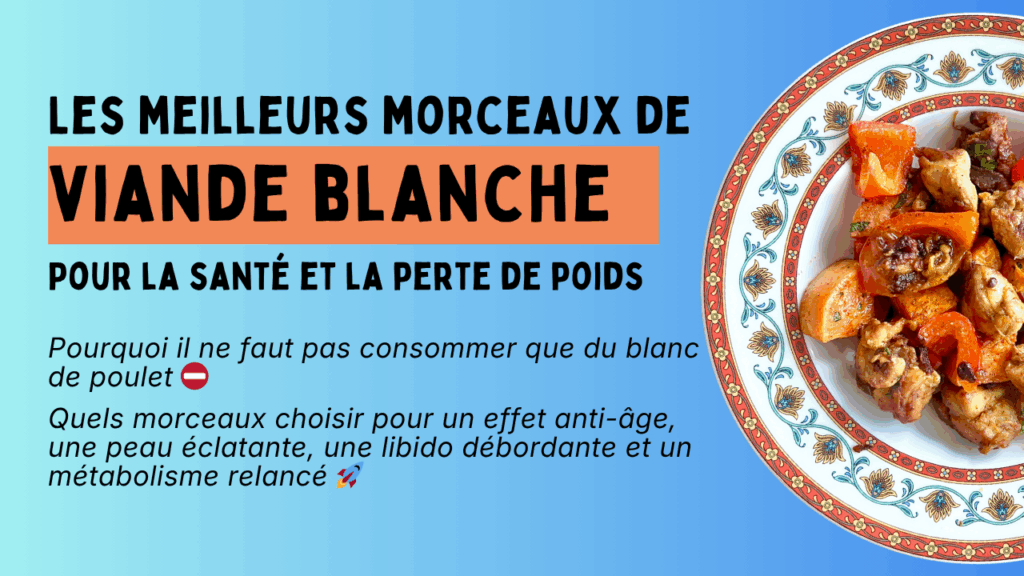
Learn more about traditional white meat cutting (chicken, turkey, and poultry) and discover the best cuts of chicken, poultry, pork and game for your health and longevity, whether you're on a carnivorous diet or not, ketogenic, lowcarb, paleo or more generally Mediterranean or omnivore with this comprehensive guide to eating white meat for vitality. At the end of this chapter, your ready-to-use PDF shopping list to shop online or at your favorite butcher.
Table of contents
Hide- 1.Part 1 in podcast format
- 2.Introduction: the right way to restore white meat to its former glory
- 3.What you'll learn about the healthiest cuts of white meat
- 4.The benefits of reintegrating fatty foods into the keto / carni / lowcarb and Mediterranean diets
- 5.A reminder of the protein/fat ratio
- 6.A reminder of cooking methods
- 7.The central question of monogastric digestion
- 8.Interesting keto/Mediterranean criteria for white meats
- 8.1.1st criterion: Methionine/Glycine ratio
- 8.2.2nd criterion: content of Taurine, Coenzyme Q10, Niacin and other key micronutrients
- 8.3.3rd criterion: lipid profile (stable fats, Omega-3/Omega-6 ratio and CLA)
- 8.4.4th criterion: nutritional density and connective tissue richness
- 8.5.5th criterion: Cooking resistance and preparation method
- 8.6.Summary table of criteria
- 9.Part 2 in podcast format
- 10.The best poultry cuts to reintegrate (chicken, duck, guinea fowl, turkey, goose)
- 11.Popular poultry cuts not to be missed
- 12.The finest cuts of pork (free-range, Iberian, Mangalitza, etc.)
- 13.The finest cuts from game (wild boar, roe deer, red deer, pheasant, wild duck, hare)
- 14.Summary of white meat cuts to order from the butcher
- 15.Ordering summary in PDF format
- 16.List of simple phrases to communicate to the butcher
- 17.Ideal consumption frequency and proportions (evolutionary and metabolic vision)
- 18.Conclusion
Part 1 in podcast format
Introduction: the right way to restore white meat to its former glory
In the previous chapter of Blooness guide, the ideal food guide, we discovered what were the best cuts of beef and red meat? to reintegrate when the goal was full health through diet and lifestyle.
This content is therefore the counterpart of what we did for the red meat, but this time we're going to focus on the white meat, and also to the pork, which is a red meat, but which we'll cover here for the sake of simplicity. We'll also look at game, which abounds in meats that are seldom eaten, but which are nonetheless one of nature's treasures, allowing us to further diversify the sources of meat to be consumed.
In addition, we have already reminded you of the importance of identifying good red meat chains on the one handand white meat on the other, In addition, we are committed to reducing our exposure to residues of pesticides, antibiotics, vaccines and GMO soy, and to avoiding meat with an excessively inflammatory fatty acid profile.
This content is part of the guide Blooness, the guide to the ideal human diet, the summary of which you can find here 🌱🥑
We also found out which ancestral feeding habits of ruminants (cattle and sheep)and natural poultry feed so as to identify the channels that are trying to come closest to what animals should consume in evolutionary terms, and how they should be raised.
In the end, the challenge is to consume meat from animals raised in a way that is as close as possible to their natural, ancestral environment, so as to come as close as possible to a nutritional profile for which we would be evolutionarily suited. All this while ensuring that we consume these foods in their entirety, in a way that reproduces what the hunter-gatherer could consume in terms of proportions.
In this chapter, we will discover which cuts of white meat, pork and game to choose for health, longevity and weight loss, Just like what we discovered with red meat, the common mistake is to limit yourself to thin cuts such as chicken breast or pork tenderloin, which can lead to a nutritional imbalance and a lack of fats saturated or monounsaturated. This makes us miss benefits of fatter, more gelatinous meats richer in collagen or micronutrients.
In the case of white meat or pork, experts in the ketogenic and carnivorous spheres stress the importance of vary lean cuts with fattier ones (such as chicken thighs, skin, pork loin and offal for example) in order to support ketosis and optimize energy, for those on a ketogenic diet, or at least to ensure that part of their energy intake is provided by food. lipids for those who are not necessarily in nutritional ketosis.
Speaking of which, it's worth remembering that this part of the Blooness guide is not just for those who are in keto. In fact, we inspire from best practices from the keto sphere to make the most of it, and to adapt it to all dietary practices, while taking care not to do anything contradictory, such as a diet rich in carbohydrates, and rich in lipids, over a long period of time.
In fact, the purpose of this guide is to bring together best food practices from all over the world. And it has to be said that keto diet researchers are particularly prolific at this game. In fact, it would appear that these keto-carnivore diet experts have put their finger on two central components of health and longevity:
- on the one hand favour the consumption of proteins quality animal feed (from land and sea) ;
- on the other hand reintegrate fatter, more gelatinous pieces (typically, cuts that need to be simmered and cooked for long periods, thus harvesting micronutrient- and collagen-rich broth), not to mention offal or the use of animal fat for cooking rather than vegetable oils (such as beef tallow, pork lard or duck fat, which nobody uses anymore).
While the consumption of fatty meats is intended to support ketosis, it is nonetheless an essential part of a healthy diet. a key component of healthy longevity, even for those who don't necessarily want to follow a ketogenic diet.
On the one hand, fatty parts of the animal kingdom, long shunned or even discouraged, bring their share of benefits for hormonal, tendon and tissue health, and more generally for metabolic health. And secondly, many people are unknowingly in intermittent ketosis, This can be achieved by reducing carbohydrates or eating less frequently.
Consequently, it's not unreasonable to think that prolonging this intermittent ketosis induced by a more or less long fast, which is sometimes not really voluntary, is a beneficial thing for the body, as long as carbohydrate intake remains moderate the rest of the time. And there's nothing like a high-fat food intake to prolong this ketosis, moving from fasting ketosis to nutritional ketosis.
Reintroducing «forgotten» cuts of red or white meat, or even tripe, helps prolong the feeling of satiety, supports ketosis - however intermittent - and provides lipids and micronutrients that modern diets have discarded.
Fatty meats are therefore not limited to a ketogenic or carnivorous diet., Far from it, and as usual in this guide, we've drawn inspiration from the best of what's out there, drawing on a variety of dietary practices to produce a synthesis, a dietary «ideal». After that, it's up to each individual to make his or her own choices, with the help of a doctor or nutritionist, of course.
All this to say that when it comes to meat, it just so happens that research and feedback are particularly well documented in the keto carnivore sphere. And that a low-to-moderate carbohydrate diet appears to be an extremely effective approach to regaining health and a healthy weight.
That's why lowcarb is one of the pillars of the Blooness Guide, in addition to the Mediterranean diet, which, contrary to popular belief, also defends the consumption of meat (and fish), as long as it comes from an animal raised in the most natural way possible.
In this respect, several Mediterranean regions have remarkable life expectancy statistics (based on previous generations), which are correlated with a raw diet, not only plant but also animal, with a significant proportion of dairy products (ewe's and goat's milk cheese in particular), quality charcuterie, white meat and, of course, fish and seafood. fruit sea.
This guide to best cuts of white meat aims to make rediscover cuts of white meat (and pork) that we're used to limiting, by favouring extensive production methods (free-range, natural food without cereals intensive) to avoid the inflammations associated with conventional breeding, whatever the diet, ketogenic or not.
What you'll learn about the healthiest cuts of white meat
These are the themes we'll be exploring here:
- Traditional cuts of chicken, turkey and pork; ;
- Nutritional characteristics of each piece (including fat, collagen and micronutrient content); ;
- A practical list of the best cuts for a keto / carnivorous / Mediterranean diet ;
- Tips for ordering or cooking these cuts; ;
- Magic phrases to say to your butcher or type into an online ordering site (e.g., «Free-range chicken thighs with skin» or «Iberian pork loin»).
The benefits of reintegrating fatty foods into the keto / carni / lowcarb and Mediterranean diets
Let's start with a quick reminder of the benefits of reintroducing fatty cuts of animal origin to keto and carnivorous diets, as well as to Mediterranean diets with moderate carbohydrate intake.
In fact, what most people don't know is that animal fats are essential for energy and satiety. As we mentioned for red meats, The idea is to reintegrate red and white meats, which contain between 15 and 20% of fat, something that most people, paradoxically, try to avoid.
In doing so, the aim is to «mimic» ancestral diets, at the very least the diets of our grandparents and great-grandparents, where animals were consumed. almost entirely, In fact, before the advent of carbohydrate-rich products, fat was the «normal» fuel for human beings. In fact, before the advent of carbohydrate-rich products, fat was the "normal" fuel for human beings.
Especially in ketosis, fatty acids and ketones replace glucose as the main source of energy. Animal fats (saturated and monounsaturated) are an ideal substrate when adapted to the combustion of fats and ketones: they stabilize the blood glucose, They support satiety (via leptin, the hormone that sends the satiety signal) and protect thyroid function.
As a reminder, the thyroid is now a major health issue, This is because it affects growth, reproduction, sleep, hunger and metabolism, via the production of hormones that act on the entire organism. And it just so happens that thyroid problems are the cause of many health problems, Many of those affected are unaware of the cause, and of the fact that reintroducing fatter, more gelatinous, micronutrient-rich cuts could delay, not to say reverse, many hormonal and metabolic problems.
Hence the importance of eating enough fat from the diet, whether to boost metabolism, improve hormonal health, regain energy, vitality and libido, not to mention the benefits of collagen- and glycine-rich morsels, a topic we'll cover a little later in this content.
A reminder of the protein/fat ratio
Secondly, we're not going to go into detail again on the reminders we've given in previous Blooness guide content on the ideal ratio of protein / fat, as well as cooking methods, which we have already covered, particularly in the chapter on the best cuts of red meat.
But very briefly, ideally, in keto, 70% of calories can come from fat and 30% from protein, which corresponds to about 1g of fat for 1g of protein. It's important to understand conversion grams / calories not to engage in low-calorie, weight-loss diets, but rather to learn how to consume food in the right proportions for the metabolism.
A chicken leg, for example, contains around 15g of fat for 20g of protein, which is an almost ideal ratio for enjoying the benefits of the ketogenic diet. You can achieve a ratio of at least 1g fat to 1g protein simply by adding a little fat during cooking, or by cooking a sauce.
A reminder of cooking methods
Always an important reminder, I refer you to the previous content to discover different cooking methods, so that you can cook alternative cuts of meat that are not necessarily suited to fast cooking methods.
A holistic approach to meat consumption requires a minimum of reappropriation of cooking methods, in order to be able to cooking fatty and gelatinous cuts, sometimes in sauces and broths, which need to be boiled, simmered or gently steamed.
The central question of monogastric digestion
Secondly, unlike ruminants such as beef, lamb and goatthe monogastric animals (poultry, pork, game birds and game animals) do not have a single stomach. So they don't practice microbial fermentation in a rumen prior to actual digestion. We have already addressed the subject of ruminant fermentation in the topic dedicated to the ancestral feeding of ruminants.
As a result, this major physiological difference profoundly influences the composition of their fat and muscle tissues, and therefore the nutritional quality of their meat.
A lipid profile that directly reflects diet
In ruminants, the rumen flora hydrogenates unsaturated fatty acids from ingested plants, allowing them to be used as a source of energy. transform into saturated fatty acids. Result: even a beef fed on cereals is likely to produce a relatively more stable fat than a monogastric, rich in saturated and monounsaturated fatty acids, and therefore a fat that will be less prone to oxidation.
Conversely, in monogastric chicken, fat composition is a much more accurate reflection of what the animal eats. :
- Poultry or pork fed on omega-6-rich seeds (soy, corn, sunflower) will have fat rich in polyunsaturated fatty acids, which are often pro-inflammatory when in excess.
- A contrario, naturally fed poultry or pork (seeds, insects, grasses, acorns, worms, berries, roots, depending on the species) will produce meat with a much better balance of omega-3, stable monounsaturated and saturated fatty acids.
This is why, from a keto, carnivore or simply metabolic perspective, It's crucial to know where the animal comes from, especially if it's poultry or pork., This is because the lipid profile of these meats is even more influenced by diet than that of ruminants.
Meats richer in unsaturated fatty acids, and more sensitive to oxidation
In addition, regardless of diet, poultry, pork and game meats contain :
- More unsaturated fatty acids than ruminants (especially if raised on cereals): this gives a softer texture and milder taste, but also instability.
- Since there are fewer saturated fats, these fats are less heat-stable.
There is therefore a risk of increased oxidation during baking of these meats, which justifies a gentler cooking process (low-temperature, simmered, confit, and with stable cooking fats such as beef tallow, ghee clarified butter or duck fat).
In short, white meats and pork have a lipid profile that differs from that of ruminants, slightly higher in unsaturated fats, which can sometimes justify combining them with stable saturated fats in order to reproduce ancestral proportions between saturated and unsaturated fatty acids.
What's more, as the diet of these so-called monogastric animals has an even greater influence than that of ruminants, and in our modern societies, poultry is consumed far more than beef, and far more than fish, it's important to pay extra attention to the origin of the animal, the way it was raised and the feed it was given.
Poultry, pork and game: the same battle?
All these reasons lead us to combine poultry, pork and game in the same family, even though pork is technically a red meat. Among the reasons for this choice are the following:
- all are monogastric,
- their nutritional quality depends even more on their diet than that of ruminants,
- and their lipid profile differs significantly from that of ruminants.
This category represents a family of meats that we felt should be broken down for the purposes of this guide to the ideal diet. As always, the challenge is to vary tracks and sources as much as possible to make the most of what nature has to offer.
Interesting keto/Mediterranean criteria for white meats
And to get the best out of these meats, it's not enough to «eat poultry or pork»: you have to know how to alternate cuts, from the right farms, and prepare them in the right way.
As such, here are the main criteria we've selected for this guide, to put the spotlight back on those pieces shunned by most consumers.
1st criterion: Methionine/Glycine ratio
This is probably one of the most important criteria for longevity and metabolic health.
As we saw in the chapter on red meat, the methionine is an amino acid that is abundant in lean meats (such as tenderloin, poultry breast or roast pork), and although it is an essential amino acid, it is potentially pro-oxidant when consumed in excess of glycine.
Visit glycine is another amino acid found in collagen, skin, tendons, rinds and gelatinous pieces. It comes from neutralize the negative metabolic effects of excess methionine (such as inflammation, accelerated aging and oxidative stress).
Here are the main benefits of Glycine intake and a balance between Methionine and Glycine:
- Reduced chronic inflammation
- Longer service life
- Better digestion
- Better sleep
- Better recovery
That's why glycine is found in so many dietary supplements. However, the best way to absorb it is through natural food (collagen, rind, broth and animal fats).
The aim is to balance the Methionine/Glycine ratio trying combine collagen-rich cuts with leaner cuts. And from an evolutionary point of view, we could hypothesize that we have adapted over the millennia to a certain ratio that was naturally found when we consumed the whole animal, but that this ratio became unbalanced when we began to consume only the same lean cuts.
2nd criterion: content of Taurine, Coenzyme Q10, Niacin and other key micronutrients
The second criterion is to identify pieces that are relatively rich in taurine, Coenzyme Q10, Niacin and micronutrients.
These compounds are essential for mitochondrial function (mitochondria are the «energy factories» of the body's cells), to the recovery and cell longevity. They vary greatly according to muscle type (endurance vs. power), oxidative density, and the amount of connective tissue or blood.
Here are the characteristics and benefits of each of these compounds:
| Nutrient | Role | Richest tracks |
|---|---|---|
| Taurine | Amino acid, major antioxidant, regulates electrolyte balance, supports bile (essential for fat digestion) and the cardiac function | Heart, leg, pork |
| CoQ10 (ubiquinone) | Enzyme cofactor, a kind of vitamin liposoluble, which plays a role in transporting mitochondrial electrons (aiding energy production), and supports the health of the heart and muscles | Heart |
| Niacin (B3) | Precursor of NAD⁺, an essential molecule for the cellular energy production and DNA repair | Poultry (legs, turkey), pork, game |
| Micronutrients : Zinc, Iron heme, Selenium | Immunity, thyroid, metabolism | Game, pork, dark poultry |
| Vitamins B6, B12 | Methylation (an essential chemical process that affects many of the body's functions), energy, neurotransmission | Poultry (legs, liver), pork, game |
Finally, the pieces that are rich in taurine, CoQ10, vitamins and micronutrients are often those that are the most vascularized, the darkest and the closest to the organs, and it's precisely these that most people consider to be «secondary», «too high in calories» or »not very appetizing». This is a serious mistake in nutrition.
3rd criterion: lipid profile (stable fats, Omega-3/Omega-6 ratio and CLA)
Finally, the third criterion is the lipid profile of the meat we are about to consume. As we said earlier, on the one hand, there's the fact that the composition of fats in poultry and pork depends largely on the animal's diet, and the fact that not all cuts of meat have the same lipid profile. By reintegrating certain cuts into the diet, we can rebalance the fat intake according to the different types of fat.
The stability of saturated and monounsaturated fats
Firstly, poultry cuts, which are richer in fat, contain saturated and monounsaturated fats. are relatively stable when cooked, and are generally metabolically neutral, i.e. they have no negative effects:
- These include palmitic acid and stearic acid, These are saturated fats found in pork fat and chicken skin, and pose no danger to the body. On the contrary, they provide stable energy, and would even be anti-inflammatory in keto.
- You'll also find oleic acid, a monounsaturated fatty acid of the omega-9 type, found in duck and chicken skin as well as in olive oil. beneficial fatty acid for the body. In particular, it has a positive effect on heart health.
- Finally, it's important to note the presence of certain fats that research has shown to be extremely beneficial for the body: this is the case of saturated fats rich in C15:0, which seem to be one of the most underestimated factors in longevity, and we'll be coming back to this type of fat shortly.
The saturated and monounsaturated fats present in properly reared and fed poultry are therefore one of the criteria used in the lipid profile, but not the only one.
Omega-3 intake
We also have omega-3 fats, a type of fat that can compensate for the already adequate intake of omega-6 fats. And maintaining a balanced omega-3 / omega-6 ratio helps keep inflammation in check - sometimes necessary, but often too much.
The aim here is to consume meats that are not too unbalanced in favour of omega-6s, so as not to fuel excess inflammation, while favouring relatively fatty cuts, which should contain sufficient omega-3s if the poultry has been properly raised and fed. we have already dealt with this point in the dossier devoted to this subject.
The presence of CLA
Lastly, CLA (conjugated linoleic acid), which is found mainly in ruminant fat, can also be found in the food we eat. farmhouse pork and wild game, but in very low doses. Poultry, on the other hand, contains virtually none. As a reminder, CLA is a type of fatty acid that is extremely beneficial to the body, and we dealt with it in the content on beef.
CLA content will therefore not be a decisive factor here when it comes to meat from poultry, pork or game, and you'll need to turn instead to ruminant meat in order to benefit from CLA's goodness.
In the end, this somewhat «catch-all» lipid criterion is intended to raise awareness of the fact that there are different types of lipids that can be found in different parts of the world. fattier pieces than those usually found in meat from poultry, pork or game, and these pieces could be reintegrated into the diet, at the very least in an omnivorous diet to achieve a certain beneficial balance for the body, and a fortiori in a low-carbohydrate diet, Whether for hormonal and metabolic health, satiety or simply for the pleasure of the palate.
Of course, the consumption of fattier cuts is conditioned by the fact that thehese animals should be raised and fed properly, according to the criteria we established in the previous contents of the guide.
If the quality of the meat is average or unverifiable, it is sometimes wiser, paradoxically, opt for lean cuts to reduce exposure to residues of antibiotics, vaccines, pesticides and inflammatory fats, which are often found in fat.
To compensate, you can mix lean cuts and stable, high-quality fats, These include clarified ghee butter, tallow (beef fat), olive oil and duck fat (making sure ducks are properly raised and fed). This strategy makes it possible to controlling lipid quality without depending entirely on the lipid profile of the meat.
4th criterion: nutritional density and connective tissue richness
Then, the fourth criterion is nutritional density and, above all, connective tissue richness. This criterion covers several dimensions: mineral density, collagen content, glycine, zinc, copper and heme iron content.
Pieces that give structure to the animal (which maintain the animal's body, joints, shoulders, thighs, hocks and wings, for example) are naturally richer in micronutrients and better balanced than purely fast locomotor muscles.
Note that collagen-rich pieces include glycine and proline, which are amino acids that make up collagen, and are beneficial to health, including sleep, liver health, joints, skin, bones and blood vessels.
We can also mention the glutamine, another amino acid beneficial for immunity, intestinal health, recovery and sleep.
To make it perfectly clear:
- Glycine and Proline are amino acids that make up collagen, and are found in connective tissues such as the hock, tail, cheek, rind, skin and tendons.
- Glutamine is a non-essential but crucial amino acid, present in all animal proteins. It plays a key role in intestinal health, immunity, recovery and the production of glutathione (an anti-oxidant). It is found notably in meat, offal (including liver), bone broth and gelatin (which is a protein zone, even if it often accompanies areas of fat in meat).
Here are the main benefits of a sufficient intake of collagen and glutamine:
- Joint health
- Skin, hair and nail quality
- Intestinal and imminent health
- Better sleep
- Liver health
- Hormonal health
- Reduced inflammation
In short, this criterion can be used to identify pieces that rich in micronutrients and collagen that enable better reproduce the natural composition of complete prey, such as a human Paleolithic would have consumed: muscle + connective tissue + fat + blood.
5th criterion: Cooking resistance and preparation method
Finally, the fifth criterion, which is more an indicator than a criterion, is cooking method. As fats from monogastric animals are more sensitive to heat, cooking preparation becomes a nutritional criterion in its own right. It is therefore advisable to give preference to slow cooking (low-temperature, simmered, candied, soft-steamed, roasted), using rather stable fats (clarified butter, duck fat, olive oil, tallow), and antioxidant-rich marinades (herbs, spices, red wine, lemon, vinegar, broth).
That's why we've reintroduced pieces that are more difficult to cook, but which can be cooked for longer periods, release all their benefits for the body.
Summary table of criteria
| Criteria | What it measures | Objective |
|---|---|---|
| 1. Methionine / Glycine ratio | The balance between «anabolic» pro-methylation amino acids and metabolism-regulating anti-methylation «buffer» amino acids, particularly those found in collagen. | Preserve longevity, reduce inflammation |
| 2. Mitochondrial density (Taurine, CoQ10, Niacin, etc.) | Meat's positive effect on cellular energy and recovery. | Support metabolic function |
| 3. Lipid quality (Ω3, Ω6, stability) | Meat's ability to have a positive effect on hormonal health and to be antioxidant. | Stable, protective lipid intake |
| 4. Nutritional density & connective tissue | Wealth in minerals, collagen and micronutrients | Rebalance your meat diet |
| 5. Cooking resistance | Preserves fats and nutrients during cooking. | Reduce oxidation and digestive stress |
These criteria make it possible to evaluate each cut not on its tenderness or ease of cooking, but on its real contribution to metabolic health, longevity and satiety.
Now that we've understood the logic behind bringing back certain pieces that most consumers have shunned, we can get down to the nitty-gritty and draw up a list of the most popular pieces. ultimate list of the best cuts from chicken, turkey, pork, duck and game, This will help you to avoid falling into the trap of consuming only lean cuts.
Finally, in a second step, we will see how to combine these pieces in order to reproduce more or less the same ancestral distribution of consumption, This is based on the proportions that humans would have naturally consumed in the wild, and is still applicable today - whether you're on a keto, carnivorous, Mediterranean or simply «enlightened omnivore» diet.
Ready to go? Let's get started!
Part 2 in podcast format
Premium Membership Required
You must be a Premium member to access this content.
New: Blooness Accelerated Programs
For quick results if you are looking for
lose fat permanently,
maintain stable energy levels throughout the day,
and prevent chronic diseases.
Immediate access to the Premium Guide + all current and future programs
Limited founding rate – will soon increase to €97
 EN
EN  FR
FR  ES
ES  ZH
ZH  PT
PT