
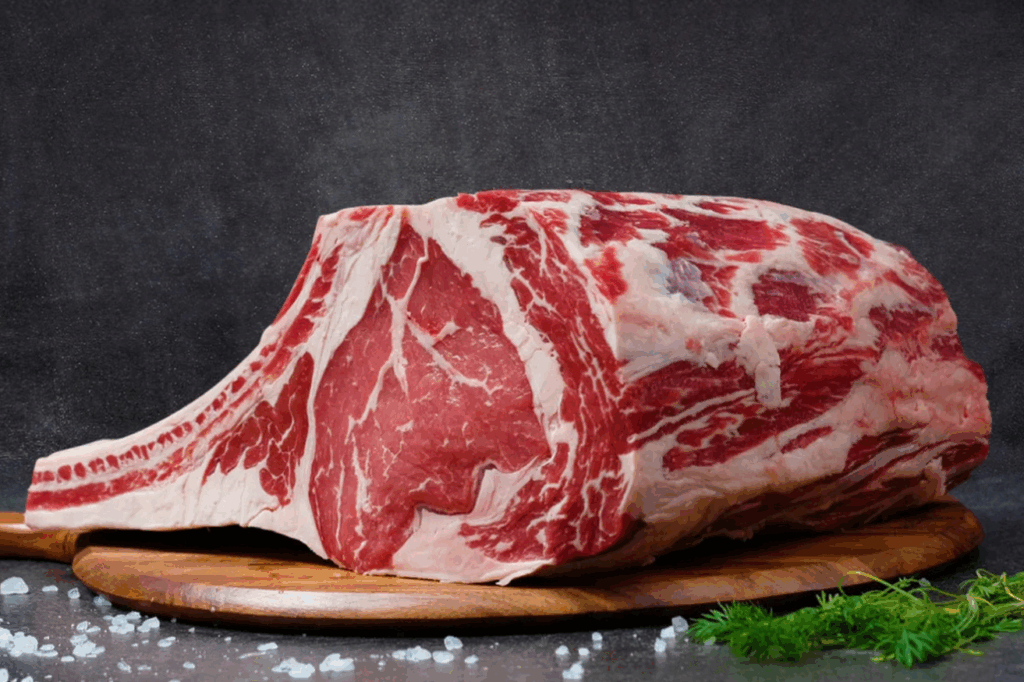
Learn more about traditional beef cutting and discover best cuts of beef for your health and the durability in a diet carnivore, ketogenic, lowcarb, paleo or more generally Mediterranean or omnivore thanks to this complete guide to eating beef for health and vitality.
Table of contents
Hide- 1.Introduction
- 2.Part 1 in podcast format - FREE ACCESS
- 3.What you will learn in this chapter of the Blooness Guide
- 4.Why choose fatty cuts in Keto / Carnivore / Paleo?
- 5.A reminder of the ideal protein/fat ratio
- 6.The importance of relearning the basics
- 7.The different cooking methods
- 8.Interesting keto/Mediterranean criteria for beef
- 9.Cutting beef
- 10.Part 2 in podcast format - MEMBERS ZONE
- 11.Basse côte (1)
- 12.Ribs and ribs (2)
- 13.Striploin (3)
- 14.Net (4)
- 15.Rump steak (5)
- 16.Round bed (6)
- 17.Tender slices, pears, whiting (7)
- 18.Gîte à la noix (8)
- 19.Spider (9)
- 20.Flat slice, round slice, moving (10)
- 21.Sirloin, skirt steak and onglet (11, 12 and 13)
- 22.Tender back and flank cuts: Aiguillette baronne, Bavette de flanchet (14 and 15)
- 23.Shoulder cuts: Rib steak, Steak scoter, Chuck, Steak jumper, Pot roast jumper, Pot roast scoter (16 to 21)
- 24.Gelatinous sections: tail, shank and hock (22 and 23)
- 25.Chest / front cuts: Flanchet, Tendron, Mid-breast, Large breast and Collar (24 to 27)
- 26.Facial offals: Cheek, Tongue (28 and 29)
- 27.Other offal
- 28.Chopped steak
- 29.Tallow (Beef fat)
- 30.Veal
- 31.Summary of the best beef cuts for health, longevity and weight loss
- 32.Cooking method according to cut of beef
- 33.Cheat sheet: list of relevant songs in PDF format
- 34.The lamb
- 35.Adult goat and sheep - Forgotten red meats, rustic and ancestral
- 36.Conclusion: your ready-to-use guide to an optimal keto / carni diet!
Introduction
If you are following a ketogenic, carnivorous, paleo or more generally keto-dietMediterranean or typical of Blue Zones, as you know: red meats and, more generally, foods of animal or marine origin rich in proteins and in fats are not just «complementary» foods to one's diet. Foods of animal origin, in particular red meat are one of the pillars of the ancestral diet, They provide proteins, but also fats for energy, and a range of essential nutrients such as ironthe zinc and vitamins B. These are all essential nutrients that are indispensable to the body, and which we have already covered in depth in the previous contents of this article.
Now that we've said that, one of the pitfalls most people fall into when they try the carnivore-dominant ketogenic diet is to always eat the same relatively muscular cuts of meatand falling into the trap of a deficient diet.
Beyond the classic entrecôte steak or ground steak with 10, 15 or 20 % of fat, how to choose the right cuts to ensure an adequate intake of animal fats ? Which cuts to choose to respect the famous ratio of at least one to one (1 gram of protein for at least 1 gram of fat) recommended by experts such as Dr. Paul Saladino (author of The Carnivore Code) or Shawn Baker (carnivore pioneer)? And above all, how do you talk to your butcher without looking like a novice?
This content is part of the guide Blooness, the guide to the ideal human diet, the summary of which you can find here 🌱🥑
Part 1 in podcast format - FREE ACCESS
Many influencers and researchers in the ketogenic sphere constantly repeat that animal protein and fat must be put back at the heart of the diet, but in practice, very few prescribers take the time to explain how to do it. As it happens, knowledge of meat has been lost from generation to generation, and if you talk to the younger generation about chuck, shank, round steak or cooking methods such as braising or simmering, you're likely to lose most of your audience along the way.
And yet, the very essence of the ancestral diet is to reconnect with these forgotten cuts and alternative cooking methods, to alternate the consumption of grill steaks, which are easy to find in supermarkets and convenient to cook, with pieces richer in collagen and glycine, lesser-known and considered difficult to cook, even though they are, in fact, very popular. indispensable for health as part of a holistic low-carb, high-fat approach, because they provide essential nutrients that muscle meats don't necessarily provide.
What you will learn in this chapter of the Blooness Guide
In this new Blooness guide, we will :
- plunge into the world of traditional beef cutting ;
- discover characteristics of all beef cuts ;
- to draw up a practical, ready-to-use list of best cuts of beef to be consumed from a keto / carnivore for health and longevity ;
- learn to formulate language elements to pass on to your favourite butcher or use as keywords on online ordering sites for virtuously raised beef.
First and foremost, it's important to remember that you must give preference to meat from extensive farming, for both animal welfare and human health. The higher the fat content of a meat, the more important it is to ensure that it is a quality meat., Fat is a double-edged sword: it's probably the best provider of energy for human beings, but it can also poison us slowly if it comes from animals raised in intensive livestock farms and fed on cereal feed and soy or corn meal.
In this respect, we have already dealt with the different rearing methods in the other contents of the Blooness guide.
So once we've identified an industry that meets the quality criteria, we can then learn how to choose the pieces and to vary them as much as possible, both for pleasure and for health. every piece of beef has its own health benefits, This is particularly true of cuts that are shunned or difficult to cook. However, mass consumption is focused on the best-known cuts, which makes it impossible to take advantage of lesser-known cuts.
The aim of this content is therefore to make the ancestral diet (be it ketogenic, paleo, carnivorous or more generally Mediterranean with a predominance of good fats) more accessible in terms of knowledge, and to maximize the benefits of animal proteins and fats through forgotten cuts of meat - whether purchased from the local butcher, online or in the supermarket.
Eating a wide variety of meat cuts is one of the prerequisites for getting your health back on track with a low-carb, high-fat diet, so it's very important to learn or relearn how to identify these alternative meat cuts, otherwise all the goodwill in the world won't be enough to crown a successful ketogenic, low-carb, carnivorous or more generally Mediterranean diet.
This content is therefore central. Ready to shell the beef? Let's go !
Why choose fatty cuts in Keto / Carnivore / Paleo?
Before diving into the cups, a quick reminder: the ketogenic and carnivorous diets rely heavily on animal fats to maintain ketosis (burning fat as fuel) and avoid insulin spikes. That's not to say that you have to rely on this all year round and all your life, and as we've pointed out on several occasions, this guide is intended to summarize the best in nutrition, bringing together the best practices from all parts of the world where longevity is breaking records.
But if we choose to eat meat, especially on a diet low in carbohydrates, we might as well make it the best it can be. qualitative and the most diversified possible, in line with the evolution of the human being, who hunted and consumed the whole animal.
Experts such as Dr. Robert Kiltz (carnivore specialist) insist on the following cuts with at least 20 to 30 % of fat, rich in omega-3 thanks to a predominantly grass-fed diet of the animal.
The problem is that most people are afraid of consuming too much fat. While it's true that consuming too much fat when you're sedentary doesn't help, on the other hand, the most common mistake in keto is not eating enough of it., It's a good idea to eat more fat than you need, rather than consuming too much, and not only being at an energy impasse, but also missing out on the benefits of dietary fat on satiety and the hormonal system, among other things.
In practice, fat and protein foods are generally naturally satiety-enhancing, i.e. they enable you to achieve satiety naturally and over a long period of time, without the «perverse» effect of carbohydrates, which often have the effect of not allowing you to be sufficiently «full» for long.
As a result, when you're on a diet low-carb high fat (and high fat is important here), proteins, and especially fats, act as leptin triggers, The ’satiety hormone«, sometimes nicknamed the »appetite suppressant hormone«, is conveniently produced by... our body's adipose tissue.
So, to avoid falling into the trap of not consuming enough fat, and doing apothecary calculations to find out how many calories we should consume, the easiest way to start is to rely on what nature has provided for us: fat. satiety. And so consume proteins and fats without rushing through a meal, until we are no longer hungry.
This is one of the secrets of weight loss diets that work, and of regaining control of metabolism and health. By doing this, we give the body a «springboard effect», We give it energy and vitality to boost its metabolism, giving it the opportunity to burn more calories via fat, and thus spend more in everyday life, without necessarily realizing it, especially if we add physical activity to the mix.
And so, the fats consumed at satiety «restart» the metabolic machine, allowing us to to accomplish more tasks. This makes us more resistant to life's adversities, less cold, more alert, more prolific on the cerebral level, and these dietary fats constitute a «bridge» towards the combustion of our adipose reserves, firstly because they are a similar substrate for the body's need for energy, but also because thanks to the feeling of satiety that lasts long enough thanks to the lipids, As a result, we're less tempted to snack repeatedly. And yet, these repeated snacks block lipolysis by nature (lipolysis being the process of burning our fat), as well as boosting the secretion of insulin, which is an anabolic hormone, preventing the body from drawing on its reserves.
Here again, it's important to keep things in perspective: the aim is not to prevent yourself from snacking, It's important not to impose it as an obligation or a habit. Snacking can be a gourmet's pleasure, or a regressive, guilty pleasure, to be enjoyed and not intellectualized or regretted. Nevertheless, multiple daily snacks with no particular hunger are missed opportunities to tap into fat reserves, for an individual seeking to maintain a healthy weight or lose weight.
All this to say that eat fatty cuts (sometimes as a snack, by the way) is not only relevant but also almost indispensable when embarking on a lowcarb highfat, ketogenic or carnivorous diet. This is not to say that lean cuts such as chicken fillet or beef flank steak should be absolutely banned, but simply that it's a good idea to vary the pieces. As you can see, in an increasingly polarized world, nuance is one of the pillars of this guide.
Lean cuts therefore have their place in a low- or moderate-carbohydrate diet, but only if they are vary with fatty cuts, or simply by sources of fat. And among the best sources of fats recommended in this guide are coconut oil, lard, beef fat, butter made from raw milk, clarified butter made from raw milk and olive oil.
Longer or shorter periods of lean meat consumption may be appropriate during very short-term low-calorie diets, but should not be abused to avoid slowing down the metabolism and triggering the body's warning system.
A reminder of the ideal protein/fat ratio
When we cross-reference both science and the recommendations of keto experts, an «ideal» piece of meat would provide around 70 % of calories from fat and around 30 % from protein. This doesn't mean that 70% of the food's weight is fat: we're talking about calories here, and since fats provide more calories than proteins, when we relate this to food weight, it comes down to having around 1 gram of protein for every 1 g of fat.
Concrete examples
- Entrecôte: approx. 20 g fat / 18 g protein → perfect for keto.
- Rump steak: approx. 5 g fat / 22 g protein → too lean (≈ 20 % of kcal in fat).
- Ground meat 30 % MG: approx. 22 g fat / 17 g protein → excellent keto ratio (≈ 70 % of kcal from fat).
As a reminder, we had already made a complete course on how to convert calories into grams and vice versa, and estimate the protein and lipid content of a food bowl.
Furthermore, as we saw in the chapter devoted to the best red meats for your health, It is recommended for keto/carni/Mediterranean diets and even for omnivorous diets in general. identify meat production channels for ruminant animals that are mainly grass-fed, because fats from intensively farmed animals fed with cereals and soybean meal contain toxic residues and are inflammatory for human health. We have already identified the relevant sectors in the content devoted to this subject, which I highly recommend you consult.
As a reminder, we have already covered the ideal protein/fat ratio in several Blooness contents, including the content dedicated to the ideal protein intake in a ketogenic or low-carb diet.
Having said all that, we'll soon be able to move on to cutting up a beef, but before we do, there's another important reminder to be made, and that's to realize that we need to relearn traditions in order to better apply theoretical concepts of nutrition.
The importance of relearning the basics
The work we are going to do here is of public interest. The problem is that the generations born after the 1980s - of which the author of this guide is one - have never been made aware of these notions, as the industrialization of food, easy access to supermarkets and standardized food, and more recently home delivery of pre-cooked food, have all served to bury this traditional knowledge handed down from generation to generation.
Initially, this guide was not intended to pass on traditional practices, nor to defend any conservative values. From the outset, the aim has always been the same: to optimizing healthy longevity. And that means mimic the ancestral diet from which humans have adapted over the millennia (and millions of years), based on the assumption that we would be better adapted to this ancestral diet to modern diet and lifestyle.
It is therefore a pragmatic goal, which is based on the premise that precautionary principle. So there's no particular desire to defend a culinary heritage or ancestral know-how, even if the intention is laudable.
As we seek to pursue our original goal of healthy aging, we discover that the know-how of our ancestors bodes well, because in our case, it's the know-how that enables us to understand how human beings were able to consume the animal (in this case, beef) from head to foot, and thus reproduce it at our level.
As we have repeatedly reminded you in this guide, the pitfall is to eat lean meat almost exclusively on a keto / paleo / carnivore diet, via the same cuts of red meat for quick and easy grilling, available in supermarkets or as chicken fillets, This is not only because it doesn't correspond to the ancestral meat diet, which is by nature more varied and holistic. Firstly, because it doesn't correspond to the ancestral meat diet, which is more varied and holistic by nature, and secondly, because it can quickly become off-putting.

The objective is therefore clear: more or less reproduce what was done in the past in terms of proportions of animal parts consumed, Rather than eating only part of the animal, which makes no evolutionary sense.
The different cooking methods
To consume an animal in its entirety, and in this case beef, it's important to be aware of the following points different cooking modes so you can enjoy every part of the animal.
That's right, certain cuts will require special cooking methods that most of us have forgotten, in favor of quick grilling or pan-frying of chopped steaks, rib steaks or rump steaks.
Before discovering the different cuts of beef, it's essential to learn about cooking methods, which we'll describe here very briefly to help you understand the basics, and which we'll cover in full elsewhere in this guide.
Pan-frying or grilling
The first and most commonly used cooking method consists of grill quickly a piece of meat, while generally keeping the inside relatively juicy. The crust created on the outside, which is pleasant to the taste (and probably less pleasant to the health), is known as the Maillard Reaction.
This cooking method is particularly well-suited to minced steaks, beef flank steak, rib-eye steak, rump steak and entrecôte.
The ideal fat for this cooking method is suet (beef fat), lard (pork fat, but properly raised!), clarified butter or coconut oil, we have already covered the best fats for different types of cooking in the Blooness guide.
Simmered or braised cooking
Next, we have the cooking process, which consists of making simmer or braise pieces of meat. This is a long cooking over low heat, with a liquid base (broth, wine, water) that tenderizes pieces rich in collagen and connective tissue.
Suitable cuts include chuck, scoter, shank and collar, which are rich in collagen and gelatin.
Oven cooking
Then, the third cooking method consists in making roast meat pieces, and the roast consists of bake meat in the oven. The particularity of this cooking method is not linked to its duration, as roasts can be short-cooked (for rare roasts, for example) or long-cooked (for shredded or confit roasts). On the other hand, the characteristic of the roast is that it is a even, dry heat cooking.
It's a cooking method that's ideal for basse-côte, plat de côte, gîte or low-temperature confit chuck. Cooking can take several hours, and when ketogenic, part of the meat can be immersed in cooking fat or stock.
Cooking in broths and stews
Another cooking method that is very famous in the gastronomic tradition but much less practiced in households is the cooking in broth or pot-au-feu. The aim here is to boil food during slow cooking, by immersing meat in a large volume of simmering water, often flavoured, with vegetables, marrow bones, herbs.
This is a traditional cooking method for shanks, chops or chuck. And the nutritional advantage here is that you're keeping the meat in the pan. minerals, The result is a broth that can be eaten in part with the meat, and as a drinking or flavoring broth on the other hand.
Cooking in a pressure cooker, bain-marie or vitalizer
Finally, another cooking method consists of making pressure cooking to go faster while preserving the cooking juices thanks to the pressure cooker, or without pressure with a vitalizer or bain-marie to retain all micronutrients and flavors while avoiding the Maillard reaction and food oxidation.
So much for the main cooking methods. Now it's a question of choosing which cooking methods to use, depending on the cut chosen, which brings us to the central topic of this content, namely the cutting of beef, the resulting list of cuts and, ultimately, the most relevant cuts to incorporate back into a ketogenic, carnivorous, paleo or more globally Mediterranean and Blue Zones-compatible lifestyle.
Interesting keto/Mediterranean criteria for beef
Before going into detail about beef cuts, let's take a look at the main criteria determining a keto-mediterranean diet. These characteristics, specific to each cut, help us to better choose cuts and balance the variety of meats consumed, avoiding unintentional over-consumption of the same type of cut.
Cooking mode
First of all, the cooking method will be described for each piece, for the sake of knowledge, but also to identify the less common cuts (not suitable for grilling or pan-frying) which are nevertheless rich in nutrients and often neglected.
Fat intake
Then, the second characteristic we are going to estimate is adequate fat intake, The ideal target is at least 15-20 g of fat and 20-25 g of protein per 100 g of food, representing around 70 % of calories, the remainder being mainly protein and water.
It may seem far-fetched to try and identify high-fat meats for a low-carb layman, but this is one of the challenges of a healthy diet: to put the spotlight back on fat, and in particular animal fat, which has long been demonized in favor of the majority of carbohydrates consumed and refined cereals in particular. We've covered all this in the tome dedicated to low carb high fat foods.
Nevertheless, it is important to remember two things:
- the lipid content of meat is obviously an estimate, influenced by the animal, rearing and cutting.
- A lower intake is not a defect; the aim is to alternate lean and fatty cuts, to avoid exclusive consumption of lean meat.
Collagen and mineral supplements
Then, the third interesting criterion for keto / carni / or Mediterranean diet, is the contribution of collagen and glycine, calcium and magnesium. These amino acids and minerals are often deficient in the modern diet (especially if we don't consume dairy products for calcium, and with a frequent magnesium deficiency in the modern lifestyle). Yet these nutrients support bones and joints, and it is absolutely essential to provide them in some way when seeking to support healthy longevity, and potentially delay or even reverse certain modern diseases.
For the record, glycine is an amino acid found in collagen (along with proline). So when we talk about the collagen-rich parts of meat, we'll be referring to either collagen or glycine. Glycine actually neutralizes the negative metabolic effects of excess methionine (such as inflammation, accelerated aging and oxidative stress). Which brings us to the next point.
Methionine / Glycine balance
The third characteristic we identified that adds value to beef cuts is their micronutrient content (iron, zinc, B12 for energy in particular), which are present throughout beef but are more concentrated in red muscles (such as rump steak or skirt steak) and, of course, in offal (such as liver and heart), and slightly less in lean or white cuts (such as tenderloin).
Some pieces will be rich in methionine, while others will be rich in glycine, and identifying them will enable us to aim for a certain balance between the two types of amino acid, trying to boost glycine intake to compensate for the essential but already massive methionine intake, a bit like omega-3s in the omega-3/omega-6 ratio.
I explain it all in this short video on my YouTube channel:
General micronutrient intake
Another characteristic we'll be looking at is micronutrient intake as a whole (not just collagen-related micronutrients), which is certainly present in all beef, but with variations. As we said earlier, iron, zinc and B12 (for energy metabolism) are particularly high in red muscles (like rump steak or onglet) and offal (like liver, heart), while lean or white cuts (like filet) have less.
Omega-3 and CLA intake
Next, we'll look at the intake of omega-3 (present in the marbled parts of an animal fed grass and pasture for as long as possible) and CLA (conjugated linoleic acids with anti-inflammatory and anti-cancer potential).
As a reminder, in the meat we eat, but also in eggs for example, in order to improve the omega-3/omega-6 ratio in favor of omega-3s, When it comes to feed, we try to give the animal the most «natural» diet possible. So forget cereals, soy and corn cakes.
For ruminants, this mainly involves feeding them grass and hay in winter..
The omega-3 content of meat does not meet the needs that can only be maximized by a diet enriched with seafood products., But it does at least have the merit of not exposing the body to a massive intake of omega-6, which could be inflammatory. The aim is therefore to consume meats with a balanced omega-3/omega-6 ratio whenever possible, trying as far as possible to ensure that the ratio is close to one omega-3 to one omega-6.
When the cattle are fed grass, this ratio tends towards the ideal ratio of 1:1., But in an intensive diet, the ratio can be 1 omega-3 to 10 omega-6, with the risk of chronic inflammation that this can cause.
Certainly, it's not necessarily quality beef that will provide the quantity of omega-3s theoretically required by the body. Even grass-fed beef has an omega-3 content (mainly ALA, EPA and DHA) that is much lower than that of grass-fed beef. much lower than that of fatty fish (such as salmon, mackerel or sardines) or fish oils. But quality beef will at least have the merit of improving the omega-3 / omega-6 ratio, and of not «adding fuel to the fire» with a massive intake of omega-6.
As a reminder, as we saw in the content devoted to the omega-3 / 6 / 9 ratio, Official recommendations suggest consuming between 500mg and 1g of omega-3 per day.
However, some scientists recommend consuming 1 to 3 grams of marine omega-3 per day, and 2 to 3 grams of plant-based omega-3 per day.
By way of comparison, grass-fed beef would provide around 20 to 50 mg of omega-3 per 100 g of meat, compared to 1000-2000 mg in fish. This is still low, but higher than grain-fed beef (which provides only 10-20 mg per 100 g, and more omega-6).
To give an idea of what this means in practice, if we take the example of an average practitioner of a low-carb diet with carnivorous tendencies who consumes around 800 g of meat per day (this may seem like a lot to the uninitiated, but it's a commonly accepted quantity in carnivorous communities, which doesn't mean that this quantity is suitable for everyone), the omega-3 intake would in this case be :
- For grass-fed beef: Approximately 160 to 400 mg per day, which is almost half of the official recommendations - no mean feat!
- For grain-fed beef: around 80 to 160 mg per day, which doesn't even amount to 1/10th of the official recommendations.
So we can see how important it is to choose quality meat, even if you're not on a purely carnivorous diet, because when you put it all together, each improvement adds up to a whole that's always better than if you were aiming for perfection.
Quality grass-fed beef will provide around three to four times more omega-3 than conventionally raised beef, and potentially less omega-6:
- With intensive breeding (and grain-fed oxen):
- The omega-6 content is 300-500 mg per 100 g.
- The omega-6/omega-3 ratio is high: ~6-10:1
- For a carnivorous dieter, this represents an intake of 2,400 to 4,000 mg of omega-6 per day. This is not necessarily problematic, but the quality of the fatty acids consumed can pose problems, and the ratio is above all too unbalanced.
- With grass-fed breeding:
- Omega-6 intake is 150-200 mg per 100 g, half that of intensive farming.
- The omega-6/omega-3 ratio is balanced: ~2-4:1
- For a carnivorous dieter, this represents an intake of around 1,200 to 1,600 mg per day, which is a potentially reasoned and optimized intake.
Finally, as regards conjugated linoleic acids (CLA), which are beneficial to general health, they are more present in the fatty cuts of quality beef, with around 20-100 mg per 100 g in fatty cuts, compared with only 10 to 30 mg per 100 g in lean cuts, bearing in mind that human needs are estimated at 1-3 g / day for anti-inflammatory benefits.
The limiting factor when it comes to CLA in meat is therefore quite simply the low proportion from intramuscular fat (known as «marbling») in lean cuts, even with optimal grass rearing, hence the importance of alternating these lean cuts with fatty cuts, which are rejected by most consumers.
Unfortunately, fat is often removed from the plate by the consumer, or badly cooked because it requires special cooking methods, or removed directly by the butcher who has to adapt to customer demand.
Price range
Finally, we determine a price range for each piece of beef, classified into three levels The price ranges are: accessible, moderate and high, with indicative estimates in euros per kilogram.
These estimates date from 2025 in France, and reflect general averages for standard or organic / Label Rouge / grass-fed beef. They may therefore vary according to regions, countries, suppliers and future years, of course, if you consult this content a few years later; these estimates are therefore only indicators for estimating the cost of one meat compared to another.
In conclusion: a holistic balance and the return of forgotten pieces
In short, all the criteria we have just established will help us to assess the relevance of a piece on a low- or moderate-carbohydrate diet, alternating cuts considered good for keto or low-carb with leaner, more «mainstream» cuts.
One of the techniques used to identify cuts to be reintegrated is to locate the pieces that are rarely eaten - often neglected but no less nutritious - and are in fact typical of the ancestral «head-to-tail» approach advocated by keto-carnivore experts.
Cutting beef
Let's move on to beef cuts. There are different cuts in different parts of the world, but for simplicity's sake, we're going to base ourselves on the traditional French cutting. It's up to each individual to adapt to his or her own country.
Here's a diagram explaining the French cut of beef, which will help us identify the pieces. Imagine a whole beef divided into quarters: front, middle, back.
On the one hand, this work will raise our awareness of song namesto no longer seem lost when you go to your favorite butcher (and this is one of the main reasons why some people are reluctant to include alternative cuts of meat), but also to be able to identify particularly interesting tracks from the keto / carni point of view, again without abandoning lean meats, while varying the pleasures.
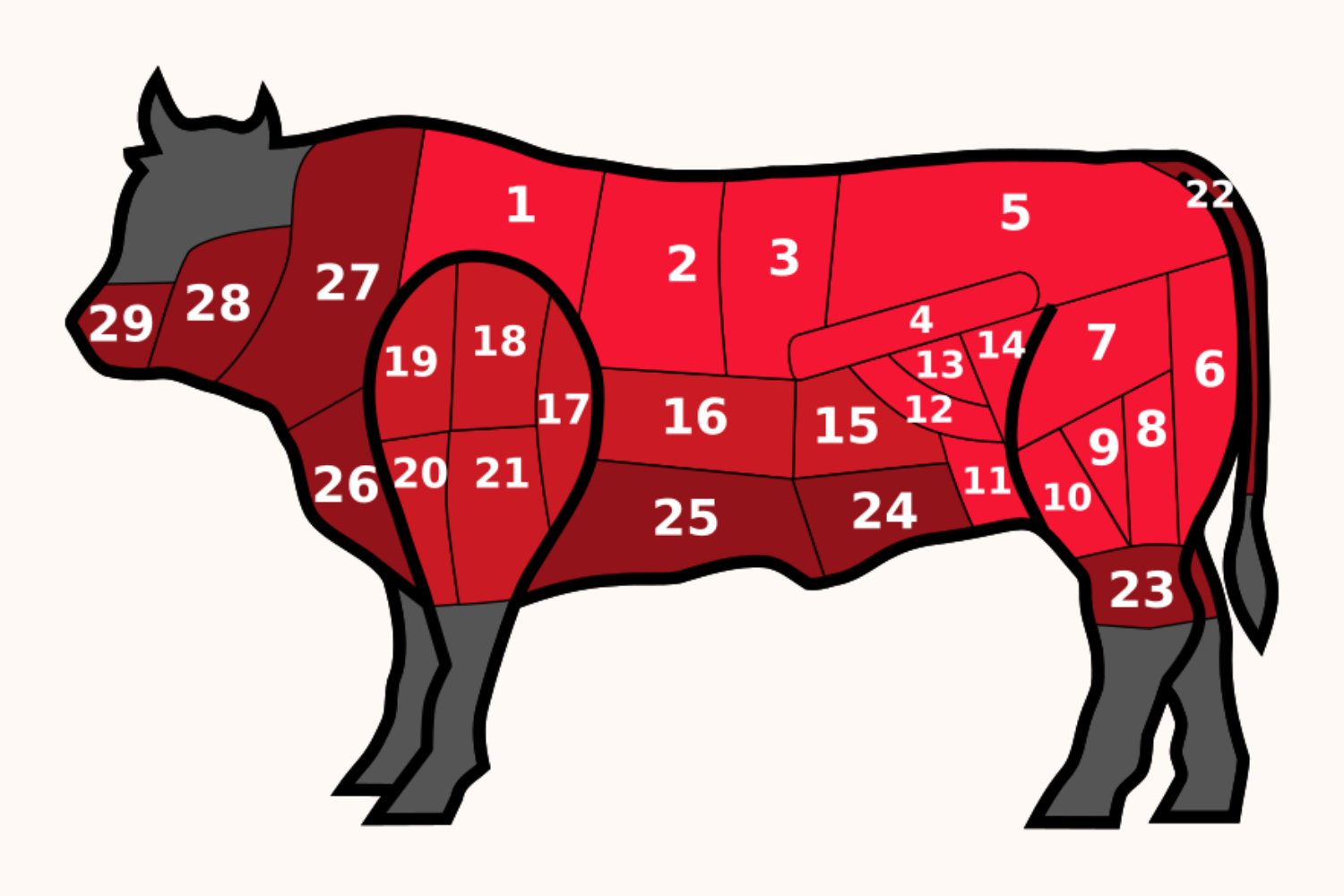
In the diagram, the least expensive parts are shown in dark red. And what's interesting here is to note that these pieces, often shunned by consumers or simply little known, are particularly interesting from a keto / carnivore point of view.
Here is a list of the pieces with their numbers on the diagram:
- Low hills
- Ribs, ribs
- Strip loin
- Net
- Rump steak
- Lodging round
- Slice tent, pear, whiting
- Gîte à la noix
- Spider
- Flat slice, round slice, moving slice
- Sirloin steak
- Spike
- Tab
- Aiguillette baronne
- Flank steak
- Platter of ribs
- Steak scoter
- Chuck
- Steak twin
- Pot-au-feu twin
- Pot-au-feu scoter
- Tail
- Gîte
- Flanchet
- Tendron, middle chest
- Large breast
- Necklace
- Cheek dish
- Language
Once again, this does not mean that we should sulk over the most consumed pieces, but rather alternate and if necessary, add fat to the leanest cuts, using sauces, butter, crème fraîche, coconut cream or milk, olive oil or ground meat from several cuts with sufficient fat.
At this point, it's important to make it clear that the subject here is not about recommend fatty meats to the detriment of lean meats from a purely gustatory point of view, Lean meats are generally considered to be the noblest in terms of taste and, in any case, this will depend on the cooking method, the animal, the way it was reared, the ingredients used, and so on. spices used, etc...
To get back to cutting, here's the complete list of beef cuts and characteristics of each piece. For each part, we will describe the appropriate cooking method, protein/fat ratio, suitability for the ketogenic diet, micronutrient and collagen content, and price range.
And at the very end of this content, you'll find the complete list of best beef cuts for health, longevity and weight loss to be integrated or reintegrated into low-carb, carnivorous or, more generally, omnivorous or Mediterranean diets.
Thanks to this list, you will no longer be lost when you visit your local butcher, supermarket or online ordering site: you will know how to alternate lean meats with fattier, more gelatinous meatswith a ready-to-use cheat sheet for perfect nutritional balance.
The first part of this content ends here, and the second part below is accessible only to Blooness members.
Part 2 in podcast format - MEMBERS ZONE
New: Blooness Accelerated Programs
For quick results if you are looking for
lose fat permanently,
maintain stable energy levels throughout the day,
and prevent chronic diseases.
Immediate access to the Premium Guide + all current and future programs
Limited founding rate – will soon increase to €97
 EN
EN  FR
FR  ES
ES  ZH
ZH  PT
PT